Tuesday, July 24, 2018

Recognizing the Hero Inside Myself

by Tess Waldrop, International Internship Coordinator


Women from the recent cohort of UVP's reintegration program
practicing their tailoring skills.
Laughter and singing echoes over the gate as we walk down the familiar red dirt road that leads us to our destination on a sunny morning in Iganga Town. As we cross the threshold of the house, I admire the numerous classic foot-powered Singer sewing machines that occupy the light filled space, where scraps of colorful kitenge litter the floor, vibrant hand sewn garments hang from the ceiling, and delicious savory smells waft down the hall. With the obvious joy that is emanating from the occupants that fill these rooms, one would be surprised to learn that their recent pasts might not match the bright smiles which now adorn their faces.

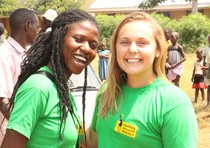
Loy and a program participant discuss UVP's
work at the International Day to End Fistula in
Mbale, Uganda.
Only months earlier, the women residing here were all suffering from obstetric fistula, locally referred to simply as “leaking.” Often ostracized by their communities, left by their partners, or even told they would never be cured, the women who now surrounded me had reached their momentous UVP Fistula Reintegration Program Graduation day. An ever-evolving and expanding program done in close partnership with various experts and community based organizations, the UVP Fistula Reintegration Program provides an opportunity for those living with fistula in eastern Uganda to receive screenings, counseling, surgical repairs, and vocational training skills. The average time UVP’s patients have suffered from fistula is an unimaginable 11 years - for most of us, it is hard to conceptualize the true weight of living with incontinence for such an extended period of time. Thus when invited to assist with conducting exit interviews with the graduating participants of this cycle of the program, my colleague Maria and I jumped at the chance to hear more about their stories and celebrate their new found health.

Evelyn and a participant from UVP's reintegration program
enjoy the festivities at the International Day to End Fistula
in Mbale, Uganda.
We sit down one on one with each woman, asking them about their experience with fistula, what they had learned while spending time with UVP, and how their dreams for the future might have changed over the course of the past two months. It may come as no surprise that these sessions were filled with many tears and hugs. What might be surprising, however, is that these were not tears of sadness or hugs given in order to console those we were interviewing. These tears were tears of happiness; these hugs were initiated when recognizing the optimism and courage displayed by some of the strongest women we undoubtedly had ever met. Identified through UVP’s Fistula Ambassadors with guidance from our Fistula Coordinators Loy Tumusiime and Evelyn Nabwiire, it quickly became clear that the support given by these two dedicated colleagues of mine was paramount in our new friends’ lives in a way I could only begin to understand. This observation was confirmed when, after one particularly long interview and soggy hug with a survivor, she turned to look at us and poignantly said “Thank you for helping me to recognize the hero inside myself.” To me, this woman had summed up in 11 words what all of us should be striving to achieve and what UVP works to do every day. Loy and Evelyn have plainly made it their job to not only make sure that they are assisting their patients in recognizing the power and opportunity which exists inside themselves, but more importantly helping them recognize that it is up to them to seize that power and opportunity and never let it go. Though many of the patients were older than my colleagues by many years, it was clear the patients looked up to Loy and Evelyn, and were ready to begin their lives anew and make their mentors and families proud.

Upon completing the program, the participants
dance with excitement to return home and start
their new businesses.
 At the end of a long day of celebrating with mounds of matooke, lots of dancing, pictures galore, and smiles from to ear to ear, we presented the survivors with the mantras which they themselves came up with. Mantras which would help them to find motivation in the days ahead and remind them of just how powerful they are:

··· “Believe in yourself!” ··· “Never give up!” ··· “Be strong, be patient, and work hard to achieve your dreams!” ··· “If you love something, you can achieve your goals.” ··· And my personal favorite, “Work with happiness every day!”

Tuesday, July 3, 2018

Yesterday, a Tippy Tap. Today, a Kitchen!

by Patrick Tulibagenyi, WASH Program Manager

Mutesi mixing the sticky dirt
to lay the bricks.
She is mixing the mud and he is laying the bricks. One by one, together, they build a kitchen. As the final sanitation facility left to build, Mutesi and her husband Hatim glow with pride when they talk about the progress they have made over the last several months. Making time and saving money can be a slow process, but they worked diligently to make this a reality.

“My husband has been supportive every time I tell him about what we learn from the sensitizations,” says Mutesi. From educational sessions conducted by the VHTs and UVP staff the family has learned the benefit of having proper sanitation facilities. Just yesterday, VHT Shaban helped them construct a tippy tap (hand washing facility) just outside their latrine. When I passed by, it was full of water, had a full bar of soap next to it, and water on the bricks below: it had been used very recently.

Hatim using his skills
to expertly lay brick.
Before the sanitation campaign, Mutesi says, “We were not bothered and no one cared about the sanitation facilities, but after seeing what our neighbors were doing and the support of the VHTs, we had no option but to join the campaign.”

Although the kitchen was the last facility to be constructed, that doesn’t mean it was the least important. Without a kitchen, there was nowhere to cook when it rained, leaving the family hungry or to cook in the house, neither being a healthy option.

Twekembe! (Teamwork!)
Making healthy changes takes time: Hatim took time away from his job to help Mutesi construct the facilities. He sees the time away not as a loss, but a gain for his wife and their four children. He sees their health as his duty.


As residents of Bukakaire, Mutesi and Hatim have seen UVP around for three years, but changing behaviors takes time. With the support of their VHT, Hatim and Mutesi intend to maintain their sanitation facilities as a reminder their neighbors to take their own health seriously. Hatim concludes, “I would feel terrible if I had a guest visit my house and no latrine for them to ease themselves. That’s no way to appreciate your visitors.”

Mutesi shows the previous 'kitchen'.

Saturday, June 30, 2018

Our Grandfather Next Door

by Alexandria Van Dall and the Naluko Village Team

Naluko intern Gloria interviews David.
"Our landlord's name is David. He's very nice and speaks some English, we should introduce ourselves as soon as we arrive. Also, he's disabled, so don't be shocked." My team leader said this to me upon arrival in our village and I was unsure what to expect. I couldn't help but think, "How exactly do people with disabilities live in the villages?" The first time I met David he sat on a low wooden bench, one leg crossed over the other, under a mango tree in our front yard. Most of the time when I see him, he's in this exact position, as if he is always waiting and willing for visitors. I make it a point to speak with him whenever I see him out on his bench -- not just out of respect, but out of genuine affection for him. David is the personification of perseverance and grace.

He has seven children, 18 years between his youngest and oldest. None of them live with him, however they do make a point to visit when they can. His first wife passed away, and his second left him after he retired. In spite of this, he speaks of them all affectionately. David has a warm stoicism about him. Often times his responses to questions are single syllables mumbled behind a wide and knowing smile. He's an archetypal wise, grandfatherly figure.

His disability is hidden when he's sitting, but when he's out tending to his pigs or in his garden the damages left by untreated polio in his childhood become obvious. Incredibly, David's relaxed demeanor doesn't shift when he's away from his front yard perch. He expertly maneuvers the yard, rhythmically switching crutches and one-handedly completing everyday village tasks that I find myself struggling with. David explained that for most of his life disabled persons in Uganda weren't granted much extra consideration, so he had to adapt to less than hospitable living, transportation, and work arrangements. He had a successful career as a clerical officer, and is now an important figure in village politics. David largely attributes his accomplishments to good fortune -- "I'm lucky my parents could afford an education for me" is his standard remark on the matter.

From left to right: Derrick, Amanda, David, and Gloria
in Naluko village.
Now that he's retired, David is a counselor for those in the village with disabilities. His opinion on various matters is held in high regard, though.  He's been a much needed, vehement advocate of our locally controversial family planning initiatives. Our friends and neighbors love and respect him, and for good reason. It is obvious to anyone who knows David that he is much more than the physical disability than passersby see -- he is an intelligent, patient, and kind person. In the short time I've been in his home, I've grown quite fond of him, and I've learned so much about the relativity of hardships.   

Friday, May 18, 2018

The Terror of Training

by Maria Nampiima, VHT and Intern Program Coordinator

It all started with a phone call.

Ok, it was actually about a hundred phone calls. After all, coordinating 65 people across 13 villages takes more than just one phone call.

It was my first time coordinating the annual VHT training, and I was so nervous that no one would show up, that I would let my team down, and the villages would never be healthy. Now that I think about it, I may have made two hundred phone calls. With the help of other staff members, we curated the agenda, looking for opportunities to spice up the health information, a way to create excitement and motivation the VHTs could carry with them for the next year.


The day of training, we arrived at the venue early, and I remained hopeful and optimistic every step of the way. We swiftly readied ourselves for the training. The 9 am start time had arrived, and to my dismay, not a single person had arrived. I stood, unbelieving, at the front of the room, staring at the dusty benches, empty and mocking me. For 30 excruciating minutes I waited; I know our VHTs operate on village time (consider time in events rather than minutes), so I wanted to be flexible. I was cursing myself under my breath and racking my brain to figure out what I could have done differently when I reached my trembling hand into my pocket to retrieve my phone and make yet another phone call. Before I finished the first phone call, a group of VHTs had arrived and, after just a few more minutes, nearly all of our VHTs were occupying the dusty benches.

Seeing all the VHTs very excited and expectant gave me courage to spice up the training as much as I could. To ensure that they take ownership of the programs from the word go, I gave them a platform to take the lead during focus group discussions and encouraged them to present information to the group on the various program areas they lead in their villages. The zeal they showed indicated the participatory activities were well received and effective.

I want to thank our staff members in Iganga for helping to deliver such a successful training. I would also like to thank you, our supporters, for constantly encouraging our work by reading these stories, commenting on our Facebook posts, and contributing financially to the benefit of rural villages.


Thank you!


Tuesday, April 24, 2018

Tailoring to Heal the Deep Scars of Fistula

by Edmond Okiboko, Managing Director

Sarah showing us her advanced sewing skills.
It’s only been a few months, but the fear of wetting her clothes is a faint memory.

“I had lost hope in life, I had no dreams, but that is all history. I’m ready to work on my big plans to change my situation. I’m on my journey for a new beginning,” Sarah declares.

We visited with Sarah a few months ago, and she shared her story of how she developed obstetric fistula and her journey to treatment. That was shortly after her return home from the reintegration camp. Now, she sits cheerful, even happier than when we met with her months ago.

Sarah moved back to her community and identified a location to start her tailoring business in a nearby trading center. To continue improving her skills, Sarah is working under an artisan mentor, Rebecca, who has been in the business for more than 30 years. Through this mentorship, Sarah is now able to make different products beyond what she learned during her reintegration program. Her emotions have changed from despair to optimism.

Proud, Sarah says, “I am now able to meet the basic needs of my four children from the tailoring business”.

Sarah is a beaming with hope, energy, and persistence. She is fully integrated within the community and no trace of fistula signs can be seen. Happiness is all she shows on her face with a bright future ahead.


Sarah and her mentor, Rebecca, sewing together in the trading center.

Tuesday, January 16, 2018

Musical Motorcar Mobilization


by Bailey Miller,  Alumni, 2016 Intern Cohort, Bufutula B Village

Bailey Pic 1
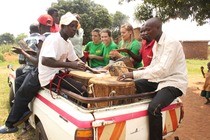
From the back of a moving pickup truck, dust kicking up behind us, my teammates and I can see the eyes of community 
members near and far light up as we shout details of the upcoming event through a megaphone. Drama group members joined us, playing drums and singing, making it impossible not to dance.

The HIV Outreach is the best event we do all summer because Uganda Village Project partners with the doctors and nurses from a government health center to provide testing for HIV and malaria, treatment for malaria, HIV counseling, deworming services, and vaccinations for children - all free of cost to community members! In addition to all of those amazing services, UVP also hires a Ugandan drama group to help mobilize for the event, perform songs related to HIV prevention and conduct entertaining skits. As interns, our role is to sensitize, or educate, the community about HIV transmission, signs and symptoms, prevention, treatment, and resistant medicines.

Motorcar MobilizationAs we returned to the site of the event, the children were chasing the truck and wanting the dancing to continue. Rose, one of my international teammates, and I continued dancing with the children. They were in pieces laughing so hard at Rose and I, and it proved very effective at attracting more people to the event. 

In total we had 270 people get tested for HIV in the village of about 300 households. Amazing turnout! The leadership skills of our Village Health Team members (VHTs) shined so brightly that day as they conducted the sensitization. This was a huge success for us as interns because one of our goals is to empower our VHTs to carry on this work when we leave and until the next cohort of UVP interns arrives.

UVP creates breath-taking moments by providing life-saving services through partnerships and empowering VHTs and their communities to advocate for their health. Just in a single HIV outreach day, so many lives were changed for the better. 

Are you interested in joining our intern cohort? Check out our website or contact Internships@UgandaVillageProject.org to learn more details of how you can implement health programming at the grassroots level.

If you would like to join us in providing life-saving health education in rural villages, you can contribute here and specify the health program of your choice.

Thursday, December 21, 2017

Mystery Can Mean Misunderstanding

By Edmund Okiboko, Managing Director

UVP intern Augustine engages with community members at an
HIV outreach in Kamira.
When a woman suddenly died, the mystery sent the community abuzz. The consensus was that she was infected with HIV. Ngobi, the husband she left behind, was distraught and confused, and began to believe their speculations and assumed he was also HIV positive.

Months later, during UVP’s biannual HIV outreach in the village, Nurse Nalwogo learned of this man’s situation and, as a long-time partner with UVP, new she needed to attempt to speak to him. She walked the short distance to his home, less than a 3 minute walk, and said, “kodi” (knock, knock, anyone home?). Ngobi welcomed Nurse Nalwoga hesitantly. After traditional greetings and inquiries of the health of family members and livestock, Nurse Nalwoga gently directed the conversation to the event, visible from Ngobi’s house. With a little more encouragement, Ngobi agreed to go with Nurse Nalwoga to take an HIV test.

To Ngobi’s surprise, he tested negative for HIV. He was not convinced of his status by this one test, so he pursued another one the following week at his local health center. It, too, was negative! Ngobi was so happy that he visited Nurse Nalwoga at her regular health center in Namungalwe to share the news. The two rejoiced.
Fast forward six months: UVP is conducting the second HIV outreach in the village for the year. Ngobi arrives to the event and immediately seeks out Nurse Nalwoga; her brief visit and encouragement to test has changed his life. The extra 10 minutes she spent seeking him out, patiently explaining the benefits of confirming his status, and educating him on ways to prevent new infections of HIV is how UVP strives to be different. Health is a journey and there are many influences in each person’s story.

“When UVP started working closely with our health center, we have also been able to reach out to villages and interact with the people we serve,” Nurse Nalwoga reflects. By building relationships with nurses at nearby health centers, UVP breaks down obstacles keeping rural communities from accessing health services.
Nurse Nalwoga appreciates UVP’s partnership approach noting that “Uganda Village Project effectively engages VHTs in all its programming and empowers them to refer patients to the health center from an informed point of view.”
She adds, “This has also greatly improved on the knowledge base of community members because they now know where to get health care services hence, making a difference.”

Ngobi’s story has been used with his permission, though his name has been changed to protect his privacy.

Tuesday, December 19, 2017

Safina’s Journey and Victory

By Maria Gorret Nampiima, Alumni, 2016/2017 Intern Cohort, Nabirere and Kamira


An energetic and confident woman, Safiina sits, smiling, during the education portion of our recent family planning outreach in Bufutula. Pursuing family planning services has not been an easy journey for Safiina: she has struggled with complications from contraceptives, battled stigma from her neighbors, and resistance from her own children.

As opposed to other health interventions, family planning causes the most debate among policy makers, religious leaders, and neighbors. Despite the negative perceptions people have towards adopting family planning methods, the prevailing circumstances in most of the developing countries have left many with no other option: in Uganda there has been an upward curve of contraception use of nearly 20% (Andi, Wamala, Ocaya, and Kabagenyi, 2014). But this increase does not come to those who lack strength.

Safiina, a mother of eight children and one of our clients in Bufutula village, shared her story about why she started using contraceptives. Similar to most women in rural villages prior to the implementation of UVP health programming, she did not want to use family planning services. She had been told falsely that contraceptives cause conditions like hemorrhage and infertility because it destroys the ovaries. Since her family depended on subsistence farming as the only source of income, she and her husband lacked enough capacity to provide basic needs to their children; clothing, education, and medical treatment all seemed out of reach. As a result of having very limited resources, she lost a child. After attending a community sensitization held by UVP and considering her personal situation, Safiina began taking contraceptives.

With 47% of people receiving their information primarily by word of mouth (Population and Housing Census, 2014), it’s no wonder rural women in Uganda do not utilize contraceptives more; nearly half of the information they receive is tainted with bias and subjectivity, which allows misconception to run rampant. UVP addresses this gap with a unique, relationship-based approach. But this takes time. And communities need people like Safiina.

Realizing her influence on her children, Safiina urged her eldest daughter to pursue contraceptive methods. At a tender age of 17, Safiina’s first born dropped out of school and is now a mother to a one-year old boy. Safiina now sees that her children’s lives could be different if she had been in a position to space her children. She wants a better life for her grandchildren.

After trying multiple methods to find the most compatible option for her body, Safiina has settled with a quarterly injection of Depo. Having taken on the initiative to utilize the family planning services, she is not worried about having pregnancies she has not planned for. Additionally, she feels energetic enough to work for her children. Although she has benefited from the program, she claims her husband is not supportive, which can make her contraceptive use challenging to continue. Despite this challenge, Safiina acts as an ambassador for the UVP family planning program.

Community members like Safiina greatly appreciate our partners and stakeholders who work hand-in-hand with us to ensure that we increase access of health interventions to people in rural communities of Iganga. On this note, we call upon all social change agents to come on board to support our programs morally and financially to continue to strengthen UVP’s capacity in addressing social inequities and injustices through facilitating health and well-being of rural communities in Uganda through access, prevention, and education.


Want to help us continue to support Safiina and other women in Bufutula? Make a contribution and specify the family planning program. And follow us on InstagramTwitter, and Facebook to see your UVP family in action in the villages. Safiina's story has been used with her permission.

Thursday, December 14, 2017

She Can Be Both: Farmer and “Musawo”

By Tulibagenyi Patrick, Program Manager, WASH


Her hands are dirty, but not because she hasn’t washed them recently. She’s been working in her garden all morning, like she does almost every day, weeding, pruning, and caring for her small crop. Catherine Namatende from Muira village is a sustenance farmer; she grows food for her family to eat and a little more to sell to cover life’s typical expenses such as health care and school fees. Staying healthy is important to Catherine; if she is too sick to work or if she has to take a child to the health center, her crop can falter and her family can go hungry. There’s a lot at stake.

Catherine also acts as a Village Health Team member (VHT), one of five people in her community dedicated to spreading positive and accurate health messages to prevent illness. UVP works directly with VHTs like Catherine to ensure they maintain updated knowledge and provide support for the work they carry out in the villages. These are the first contact persons in the village and they contribute greatly in disseminating information about health related programs in the villages.

For the past four months, Catherine and her colleagues have been moving around the village talking with neighbors about the need for good hygiene and sanitation, and have helped community members to install hand washing facilities (also known as tippy taps), dig rubbish pits, put up plate stands, and, above all, improving or constructing latrines. In fact, Catherine reported to UVP staff recently that since June, 30 tippy taps have been constructed. More importantly, she notes that she has strengthened her relationships with her community members.


Despite the fact that VHT work is voluntary, Catherine is proud of the respect that comes with her title, and enjoys her new nickname, “Musawo”, or person with health knowledge. She is constantly consulted on health-related problems and she has been in the position to guide community members and also refer them to the health center for further assistance. Catherine is proud to work with UVP; through the training provided, she has acquired more skills and knowledge related to the health problems in her home and she shares her experience with her neighbors.  

Want to help us continue to support Catherine and other VHTs in Muira? Make a contribution and specify the WASH program. And follow us on InstagramTwitter, and Facebook to see your UVP family in action in the villages. Catherine's story has been used with her permission.

Tuesday, August 29, 2017

Condom Demonstrations Attract Attention


by AnQuavis Simpson, Cally Braun, Wagaba Brenda, Arinaitwe Emmanuel, Emily Leibo, Christie Tzelios, and Bamwoze Christine

Irenzi interns demonstrating the proper use of a
female condom.
This was a big day for the interns in Irenzi. A few days before the family planning day, Irenzi interns started mobilizing by placing posters throughout the village and verbally inviting people to attend the event at the local trading center.

The day began with mobilization by biking through the village. While mobilizing, Emmanuel met a group of around 10 men in the trading center. These men had eager questions about family planning, so Emmanuel tried to answer some and promised to answer others when they come for the sensitization.

Around 40 women attended the event and the intern team presented their skit which included information about family planning methods and sexually transmitted diseases in addition to discussions with Loy and the Nurse David who answered questions and taught the women about obstetric fistula and cervical cancer.

Although the women were engaging in the sensitization, the men had not shown up, so the interns decided to collect them from the nearby shops and places that they normally gather to spend their leisure time playing games. As these interns were mobilizing, they realized that the men were still resistant and because they thought family planning sessions were only for women. 

If the men wouldn’t come to the sensitization, how could the interns bring the information directly to them in their game-playing environment? The interns quickly brainstormed and decided to request to have the sensitization between two tables of Ludo. Most of men accepted and a few refused but they decided to follow majority vote.

Similar to the sensitization provided for the women, the interns talked about sexually transmitted infections, contraceptive options, and demonstrated condom use. The men were more interested in seeing how a female condom is correctly used, so the interns started with that. Slowly, the demonstrations attracted more men from the trading center. They also educated why men should be involved in family planning and later men appreciated the interns’ efforts.

Interns conducting a soccer match to engage adolescents in a discussion about reproductive health. 


After all the educational sessions, participants were invited to see Nurse David for contraceptive services and cervical cancer screening. As women went for the above services, some interns were giving out free condoms. It was a successful day that the Irenzi team is proud to remember.

To learn more about how we implement reproductive health programming in our communities, visit our website.